Sweden has long been fertile ground for excellent synthpop. So when a new band emerges from the Nordic stronghold, I pay close attention. Asbest Inc. is the latest Swedish act to spark my interest.
The quartet combines the heavy, physical percussion of EBM with the emotional melodies of traditional synthpop. It’s hardly a new formula—Depeche Mode helped write the blueprint—but modern bands like Matte Blvck, Sleek Teeth, and Normal Bias are injecting fresh energy into the sound and making it feel like a moment. Asbest Inc. bring their own character to the combination, mixing rumbling basslines, skittering electronics, and a streak of dark humor.
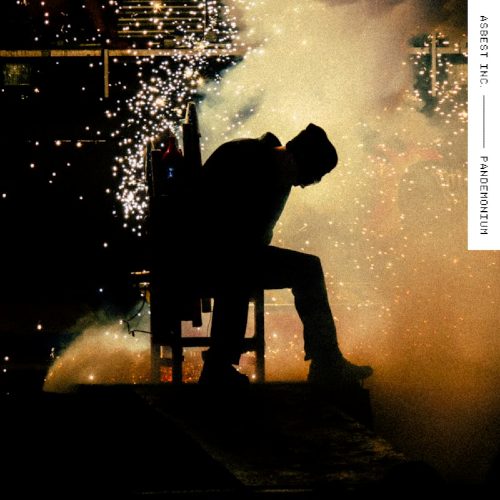
Their debut album, Pandemonium, arrives October 30. The 12-track record has been years in the making and draws from Depeche Mode, Nitzer Ebb, Front 242, futurepop, and ’80s melodies. The band describes their sound as hard-hitting beats mixed with melodic twists and dreamy soundscapes, but their real goal is much simpler: to sound like Asbest Inc.
For this month’s cover story, I spoke with Asbest Inc. band member Emelgy about their name, their unusual history, and the making of Pandemonium. Here’s what he told me.
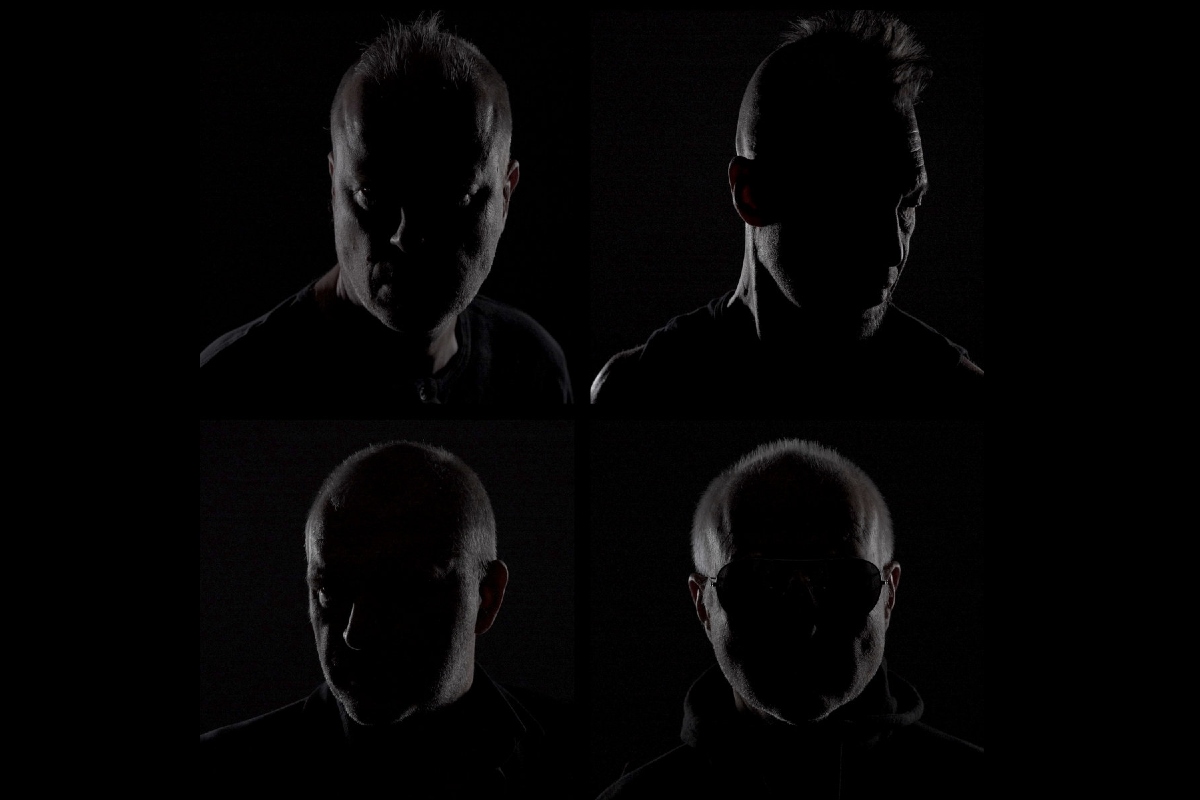
You’ve described Asbest Inc. as a collective, and there are four of you in the band photo. Who are these people, and how does each one contribute to the project?
The members of Asbest Inc. go back a long way. We’re all from different parts of Sweden, but back in the ’90s we studied media together and wanted to do something fun for a Christmas party. We programmed the song ”Wave Goodbye to Sanity” on the built-in sequencer of my Roland D-20 and enjoyed the experience so much that we wrote six more songs and did some gigs during the following years.
Then life happened and the band went dormant for quite a few years. Our singer SR3 actually worked as a cinematographer in the U.S. for a couple of years before returning to Sweden and suggested that the band should get together and do something. I had continued writing songs and had accumulated a fair number of suitable demos on my hard drive. The two of us put together a new track called “Safe to Say” (it’s on the album), remembered how fun it was to be in a band, and called Werner, who plays synthesizer, and Ådi (pronounced like audio minus the o), who plays electronic drums. They liked the idea, and here we are, ready to present Pandemonium to the world!
What can you tell us about the name Asbest Inc.? Where does it come from, and why the Inc.?
During our time at school the four of us rented a house near a commuter train station, and every morning when we went to school we noticed this poor guy sitting by the sliding doors with a sign that read ”Asbest dödar” (”asbestos kills”). It was almost like we knew the guy, and one day our singer said something like ”Hey guys, I think I know what our band should be called” and thus Asbest was born.
Many years later, actually when we decided to make an album, we did some research, and realized that Asbest is a surprisingly common name (especially among German punk bands), so we added the Inc. to make it easier to find us. I liked the idea to make the name sound a bit corporate, and we also considered Asbest Intl. before settling on Inc.
You’ve covered Depeche Mode’s “Nothing,” and there are traces of classic EBM acts like Nitzer Ebb and Front 242 in your sound. What are some influences, musical or otherwise, that might be less apparent?
Well, within Asbest Inc. you’ll find some pretty surprising musical preferences, although they might not be all that noticeable on this particular project. We’re all DM fans, but Pandemonium is mainly about pulsating bass lines and hard-hitting drums, in the vein of a Harris/McCarthy production. We actually used Nitzer Ebb’s Industrial Complex as a sonic reference during the mixing and mastering process of the album.
But if you’re looking for unexpected influences, look no further than the lyrics of ”End of Transmission.” That song was actually inspired by the final lines of an ’80s song called ”Transmission Ends” by—brace yourselves—Mr. ”Lady in Red” himself, Chris de Burgh. You didn’t see that one coming, did you?
Your debut album, Pandemonium, has been described as “a study in human self-sabotage.” What forms of self-sabotage are you exploring, and how did that idea become part of the album’s core?
Pandemonium was not written as a concept album, but when we looked at the songs, we found that a surprisingly large number of them shared this theme, or the consequences of it. There are songs about experiencing a surreal global catastrophe, songs about living in a post-apocalyptic dog-eat-dog world and songs about escaping society by going insane or getting knocked out. Fortunately I don’t get the inspiration for these songs from the real world—it certainly has room for improvement, but I don’t think it’s THAT bad.
I almost always start the process of writing a song with the beat and the bass, and when I feel that I’ve got something that might work in the Asbest Inc. sphere I try to write lyrics that fit the song.
Do you think of this album as a dancefloor record, a headphone record, or something that lives somewhere between the two?
The beat is a very important ingredient in the Asbest Inc. recipe, and if any DJ wants to try playing one of our songs in a club-like environment we surely wouldn’t mind, so if I have to choose I’d put it in the dancefloor category.
That said, we’ve filled the songs with a lot of strange noises and bleeps that you don’t really notice the first time you listen to it. The guy who did the mastering actually had to redo some songs because he brought some of the subtle background noises too far forward in the mix the first time. So maybe it is a headphone record that you can dance to?
“End of Transmission” revolves around the refrain “over ’n out — fading out.” What exactly is ending here? Is the song tied to a particular experience, relationship, or idea?
The song is—thank God—not based on personal experience. I’ve found that I often tend to start writing lyrics by inventing a persona who is totally different from myself. I ask myself how a song written by a Jehovah’s Witness or one of the supporting characters in a Mad Max movie would sound like. I’ve written lyrics from the perspectives of corrupt politicians and disease-carrying viruses.
I guess that “End of Transmission” could, metaphorically speaking, be a song about giving in to the communication problems of modern society or something, but to be honest, it really is about a guy sitting by his shortwave transmitter trying to find other survivors after a nuclear blast. And it’s inspired by Chris de Burgh.
You clearly enjoy the hardware side of electronic music. What piece of gear, software, or production trick do you consider essential to the Asbest Inc. sound—or one that you simply love working with?
I sometimes say that the Asbest Inc. sound is shaped by our preferences and our limitations. None of us are trained music producers, but over the years we have developed some ways of making things sound the Asbest Inc. way. Every song on Pandemonium was produced in Reason and seasoned with industrial samples that we’ve gathered over the years. I think that it is those sounds, SR3’s voice, and the most brutal kicks and snares that Reason can deliver that form the sound of Asbest Inc.
A lot of synthpop bands use remixes to introduce themselves to new audiences and build connections within the scene. If you could hand an Asbest Inc. track to any artist, living or dead, to remix, who would you choose?
Oh what a wonderful question! I would definitely choose someone who I believe would be able to give the song an entirely new character while still keeping it recognizable. The first name that comes to mind is of course Mr. Alan Wilder. I’d hand him all the individual tracks of the songs and then give him free rein to do whatever he likes, with no commercial demands whatsoever. That would be very exciting!