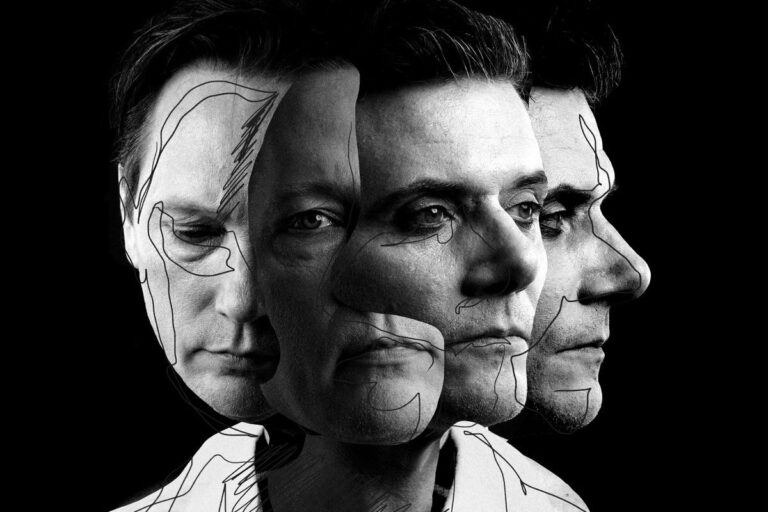
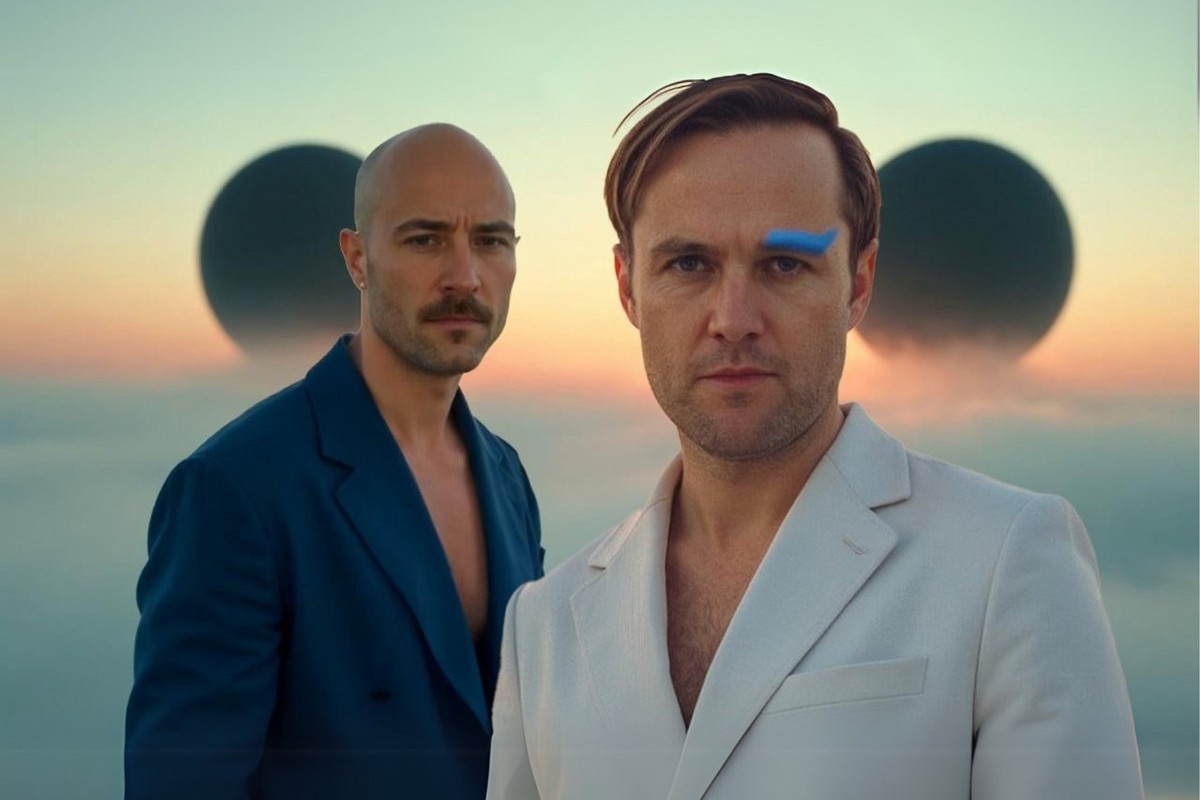
When the Austrian electronic project Lucy Dreams debuted in 2022 with an artificial band member named Lucy, the possibility of AI-generated music still seemed like the stuff of science fiction. Robot pop stars. William Gibson-like immersion. Complex compositions beyond the reach of human hands.
Fast forward to today, and AI doesn’t hold nearly as much favor. The rapid ascent of tools like ChatGPT and Suno has led many listeners to react negatively to even a hint of artificial intelligence, and music platforms like Bandcamp have moved to ban AI-generated music outright.
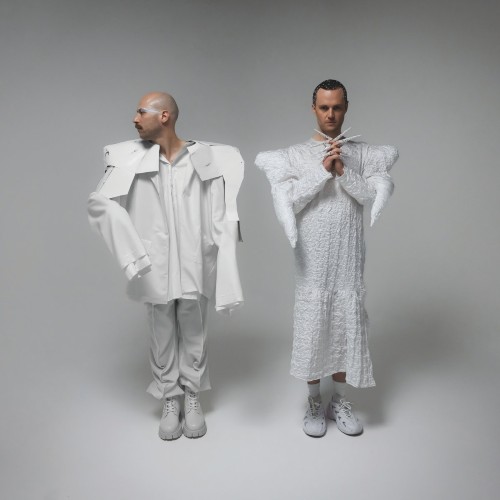
It’s important to keep in mind that Lucy is not that kind of AI. She’s a private, homegrown tool created by Zero and One—the two human members of Lucy Dreams—to help them develop ideas. That important context is crucial to understanding Lucy Dreams’ sophomore album, VVVVV, a record that imagines human intuition and technology merging together as humanity ascends into a fifth dimension. In an era defined by fear and cynicism, it dares to imagine something rarer than a dystopian warning: optimism.
On the eve of VVVVV’s release, I reached out to Lucy Dreams to ask about their music, their artificial band member Lucy, and how they feel about tools like ChatGPT. Here’s what they told me.
Your new album is called VVVVV—five Vs, the Roman numeral for five, the fifth dimension. How did the number five and the fifth dimension become the concept for this record, and what does it mean to you creatively?
We see the fifth dimension as a theoretical space beyond our perception. A state where humans and technology evolve as one, in harmony. We wrote most of the album during an intense week in a remote cabin in the Austrian mountains, and this concept of ascending beyond the ordinary became the thread connecting everything.
The details of the concept are pretty trippy: Intuition merging with technology, humanity ascending into a fifth dimension. What do you hope listeners take away from the experience?
That technology and humanity don’t have to be in conflict. The album is a soundtrack for a possible future where intuition and technology merge rather than clash. If listeners walk away feeling more hopeful about where we’re heading, we’ve done our job.
If someone wanted an entry point into the world of VVVVV, which song would you recommend—and why?
“Not Gonna Lie.” It’s the most direct expression of the album’s themes. Sonically accessible but with all the layers underneath if you want to dig deeper.
Let’s talk about Lucy, your artificial band member. Lucy Dreams predates large language models like ChatGPT and Google Gemini. How is Lucy similar to or different from those AI tools?
Lucy predates the LLM explosion, so she evolved differently. She’s more specialized—focused on musical analysis, generating variations, suggesting melodic and harmonic directions. She doesn’t “chat” or pretend to understand context the way ChatGPT does. She’s a creative tool, not a conversational partner. The big difference: we never ask Lucy to “write us a song.” We use her to expand possibilities within our own creative decisions.
Can you explain what Lucy contributes to the songwriting process, and how her role differs from yours as human musicians? Have you ever disagreed with Lucy creatively?
Lucy analyzes material we feed her and suggests directions we might not have considered. But she doesn’t understand emotional intention or narrative—at least not yet. We always have final say, and we reject her ideas often, especially when they feel clever but not emotionally true. The disagreement is built into the process.
AI has developed a complicated reputation lately—people talk about “AI slop,” loss of human intention, the environmental impact. How do you respond to skepticism about human-machine collaboration?
The skepticism is valid. “AI slop” exists because people use AI to replace human decision-making rather than extend it. Tools like Suno or Udio lose meaning once the human story disappears. For us, the line is clear: authorship, narrative, and responsibility always remain human. Lucy is an instrument. The moment she’d become the author, we’d stop.
We also advocate for transparency—audiences deserve to know how music is made. And for technology to be peaceful, inclusive, and sustainable. The environmental concerns are real and the industry needs to address them.
Your visual aesthetic is incredible. Where do your visuals come from, and how do they fit into your creative process?
The visuals are developed by the light conceptionalists Visiokratie. AI is involved in the conceptual design and generation, but always with human direction. Live, Lucy appears as a visual and sonic system reacting in real time—like a virtual band member creating a space slightly beyond reality together with the audience.
You describe your sound as “SonicWaveArtPop.” What does that term mean to you, and what other artists do you see operating in that space?
Emotionally, it’s melancholic but hopeful. Musically, it blends classic pop songwriting with futuristic textures and cinematic space. Think Depeche Mode’s emotional weight, Kraftwerk’s precision, Bowie’s theatrical imagination—basically anyone treating pop as an art form rather than a formula.