When I first became immersed in the dark music scene, synthpop had largely waned. The high-gloss sheen of the ’80s gave way to harder, grungier sounds, and electronic pop felt increasingly out of step with the moment. A handful of bands picked up the torch, but many of those acts are no longer with us. Wolfsheim split in 2005. Iris imploded in 2021. De/Vision continues, but in mutant form.
For a time, I thought Mesh might join that list. It’s been ten long years since their last album, Looking Skyward.
Finally, Mesh is back. At the end of the month, the English synthpop icons will release their eighth studio album, The Truth Doesn’t Matter, a 16-track collection that pairs their trademark emotional melodies with darker observations about the times we’re living in. The world has shifted dramatically over the past decade, entire technologies have reshaped what we consider truth. Mesh channels those present-day tensions into soaring synthpop anthems. The Truth Doesn’t Matter feels unmistakably Mesh but firmly in the now.
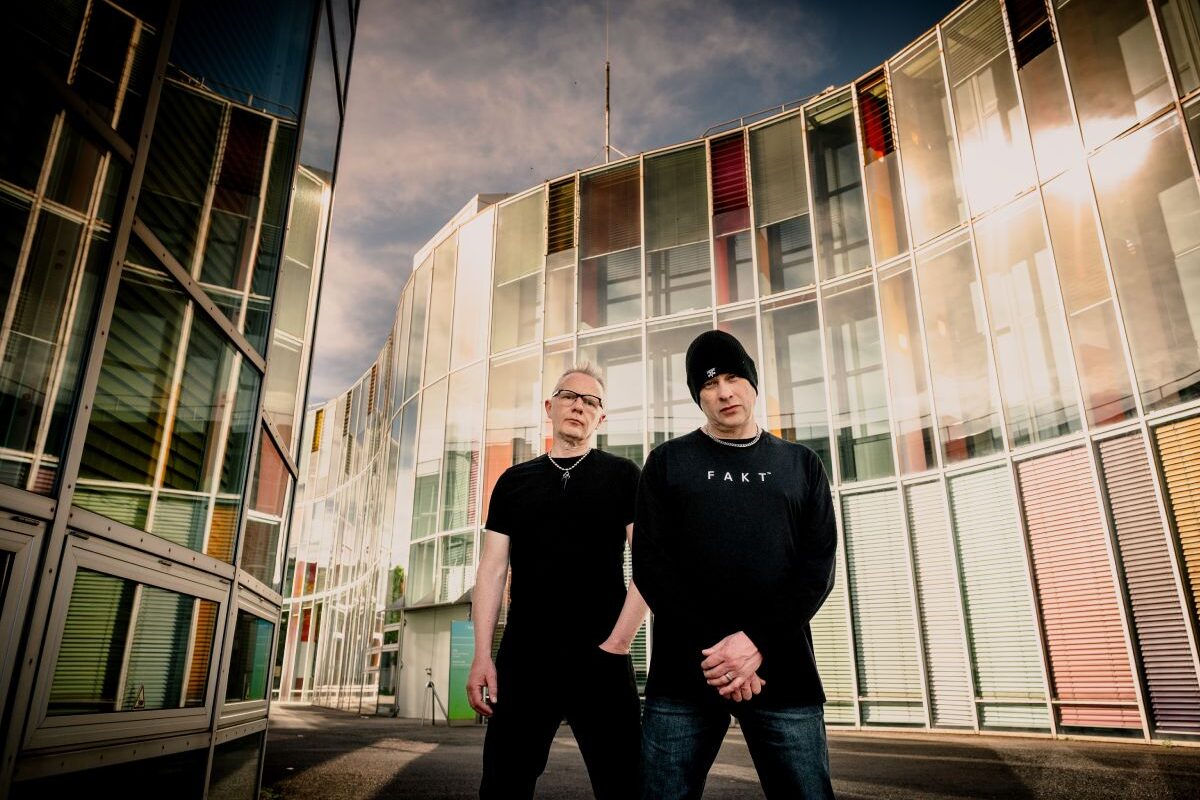
On the eve of the album’s release, I reached out to Richard Silverthorn and Mark Hockings of Mesh to talk about the long wait between albums, how the music landscape has changed, and the meaning behind The Truth Doesn’t Matter. Here’s what they told me.
It’s been ten years since Looking Skyward. What happened during that time, creatively or personally, that led to The Truth Doesn’t Matter arriving now?
Richard Silverthorn: As a band, we have consistently been writing, recording, touring pretty much from the beginning. After Looking Skyward and the tour that followed, we were both feeling a little burnt out. We just needed a bit of breathing room. Then we got talked into doing the “Retrospective Tour,” which was a tour of all our old material we hadn’t played for a long time. That was a lot of work going through our back catalogue and putting together another tour.
Then the dreaded Covid came along and the whole world stopped.
We carried on doing shows and festivals, but the focus of writing a new album did not really start until late 2023. We had a few ideas and songs, but it was a slow start. Last year was when we actually decided to put all our efforts into writing a new album. So we have had a year or so of full commitment. It kind of gains speed and efficiency when you fully apply yourself. Towards the end, we were writing quite quickly and the ideas were flowing.
Mark Hockings: As Rich said, I think we needed a bit of a break and to take a small step back. It’s been a long road and a lot of work to get us to where we find ourselves today. I certainly felt like we were locked in a bit of a cycle—write an album, record an album, tour an album, repeat. Although this is admittedly a very satisfying and enjoyable place to find myself, and I consider myself very lucky, we wanted to approach this new cycle with fresh ideas and a fresh enthusiasm for the new album.
The music landscape has changed dramatically over the last decade. What shift has had the biggest impact on how you approach making music compared to ten years ago?
Richard: Technology and the way we all access music from various streaming platforms make you wonder whether the process of making a full album is worth it anymore. For us, we have always had a loyal fan base that actually purchases physical CDs and vinyl, as well as streaming, so it still seems relevant and worth doing.
Social media has certainly become more relevant over the last decade. It cannot be ignored, as this is where you reach your audience (and new people). It’s a full-time job creating reels and content, but it’s a necessary evil that we have to do to get noticed.
Mark: The way people consume music has been changing remarkably fast over the last decade. The landscape is almost unrecognisable from the one we grew up with. That continues to be the biggest challenge in making music, not just for us but for young artists coming up.
Just writing music doesn’t seem to be enough anymore. It’s not seen to be a self-contained thing. It has to be tied into an online presence — a constant need to be seen to be doing something interesting. I personally find it a little exhausting, but I appreciate that it is a necessary evil.
The Bandcamp notes for The Truth Doesn’t Matter say “this is the age of post-factual lies.” What does that mean to you?
Richard: It is an observational view of how we as society get fed information. We all rely on the media and social media to get our news. With the explosion of AI, we have to start questioning if what we are watching with our own eyes is real.
Mark: I believe we are all currently experiencing the biggest social and technological upheaval in history. Social media has been a challenge to everyone, and our skeptical and filtering skills are being put to the test on a minute-by-minute basis. Unless we have those skills, it is increasingly easy to disappear into an echo chamber of our own misinformed beliefs and biases. If you add to that the advances in AI and (soon) quantum computing, we stand on the precipice of something extraordinary, IMO.
The Truth Doesn’t Matter is a substantial album at 16 tracks. Did you approach it as a single statement, or did it feel like a collection of individual moments that eventually added up to a bigger picture?
Richard: We just express ourselves through music. Undoubtedly, our feelings are projected through this and shape the overall soundscape. Certainly for Mark, who writes the lyrics, his experiences and observations of others come out in an ambiguous manner, leaving the listener to connect with through their past experiences.
We rarely have an agenda when we start writing. As we progress, a theme seems to jump out at us. A common thread or feeling that guides you through the latter half of the album production.
Mark: We had a lot to say. I think that maybe we thought, “It’s been a long time,” but ultimately there were no tracks on the album that we felt we could lose. It just felt right.
Mesh songs are often rooted in emotional tension and personal relationships, but they also invite broader interpretations. “Exile,” for instance, could be read as a song about refugees or displacement. Is that a fair connection? When you’re writing, do you consider global events?
Richard: Mark writes in such an ambiguous way, it leaves the interpretation down to the listener. People make their own mind up about the subject matter and connect with it in a personal manner.
After a certain amount of time, I think it would be wrong to explain exactly what the song was about as it may shatter people’s ideas of what they thought it was about.
Mark: The song lyrics are usually inspired by very solid ideas, whether those are personal or observed. The final song is, however, more open to interpretation deliberately. I get a lot of satisfaction from this approach, as it gives me the release I need, but at the same time it takes on a life of its own in the hands of the listener.
Across nearly three decades, Mesh has maintained a recognizable sound while still evolving. At this stage in your career, what feels non-negotiable about the Mesh sound—and where do you still feel free to experiment?
Richard: I think we are always trying to push the experimentation certainly with the technology we have at our disposal in the studio during the writing process. I think, ultimately, when Mark and I write, it just sounds like Mesh. The combination of both our inputs makes it what it is.
It’s very flattering these days when I read reviews of other bands and it says “it sounds very Mesh-like.” That is quite a compliment and shows we have an established sound of our own.
We have our little bits of experimentation on the album interludes. These small snippets of music that free you from the restraints and structure of a song. Just playing with sound and structuring it into an interesting piece of music.
Mark: I think the non-negotiable part is rooted in the writing and recording process. What you hear on record is an honest and emotional collaboration between two people who love what they do. We create something from where there was nothing.
Add producer Olaf Wollschläger into the equation, and we have what I consider to be the perfect setup. Every word, every note comes from us. We are not handing this stuff over to someone else to complete. Ultimately, the win or the loss rests with us.
You’ve spoken before about how strongly Mesh connects with European audiences. How does the American audience compare?
Richard: We haven’t really played that much in the US, unfortunately, but from previous experiences it has always been very good. It is certainly a step down in audience size, but that is quite refreshing sometimes. Some of the club shows we played were really cool. Hopefully we will get the chance to return someday.
Mark: It would be great to go back to the US. We had a lot of fun there. Logistics are difficult in Europe, but they have been prohibitive in the US for the kind of show we like to put on. Maybe this time, eh?
I saw Mesh in 2011 on the Legends of Synthpop tour with Iris and De/Vision. If there was a Legends of Synthpop II tour, who would you want to bring along this time?
Richard: That was such a good tour. We had an amazing time and laughed most of the two weeks we were there. So many funny experiences and memories.
I’m really not sure who I would want to do it again with. It is always a difficult and calculated decision to make these kinds of tours financially viable as there are so many costs involved. It would have to be with someone who is a little bit established over there to make it work. Maybe a band from the US with another European band. I will keep thinking 😉
Mark: Haha. Impossible to say. All of our music friends, of course! What a party that would be!