Throughout music history, numerous bands from across genres have embraced masks as part of their aesthetic. Most famously, the French duo Daft Punk spent nearly their entire career behind robot masks that amplified their out-of-this-world sheen. Metal and hard rock are ripe with mask-wearing acts, from Slipknot to Ghost to Sleep Token. In rap, there’s MF Doom. And one of the members of Kneecap wears a balaclava in the colors of the Irish flag. Masks are everywhere.
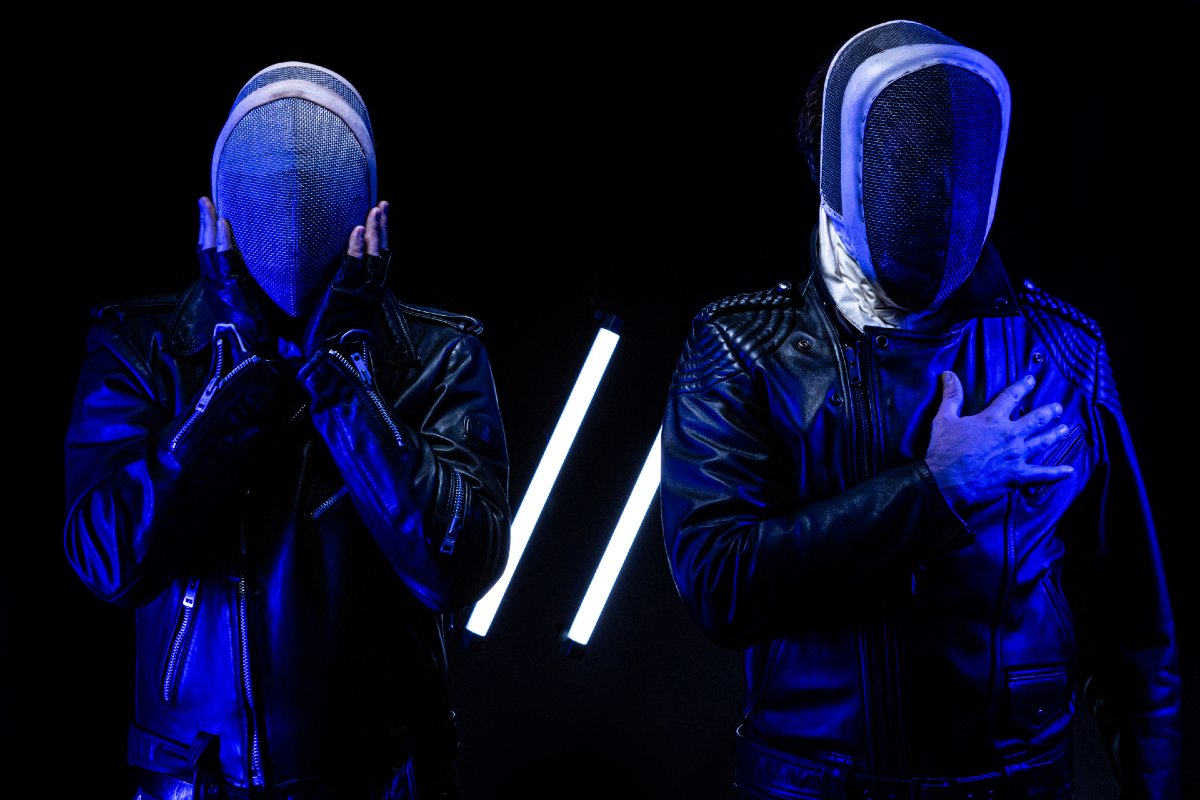
The world of modern synthpop has its own mask-wearing musicians: BLACKBOOK. Since the dawn of their career, the two members of BLACKBOOK have worn fencing masks in all their videos and promotional materials. Yes, the Pet Shop Boys donned fencing masks first on the cover of their 1995 compilation album, Alternative, but they never made masks a central part of their identity the way BLACKBOOK have.
I’ve been following BLACKBOOK since their very first song, 2018’s “Love Is a Crime.” In the years since, they’ve become one of the most reliable bands in the scene, steadily cranking out catchy, captivating singles every few months, then compiling them into hit-laden albums. This month, they’ll release their third album, Different.
On the eve of the album’s release, I reached out to BLACKBOOK to learn more about the masks and their music. I know who the two members of BLACKBOOK are, but I’m not using their names here because the masks and the mystery are part of the fun.
The fencing masks are a major part of BLACKBOOK’s visual identity. Where did that come from? Does one of you fence?
No, we do not fence. We were looking for a way to make ourselves unrecognizable because we had been in other acts before, and we didn’t want people to associate the new acts with those other projects. Also, we wanted to give the music a chance to speak for itself, instead of directing any attention to how we look.
You seemed very committed to your anonymity in the beginning. But it’s not hard to find out who you are, and I’ve seen YouTube clips where at least one of you performs without the mask. How has your thinking evolved?
At first, we wore our masks in every picture and every video, and we didn’t even mention our names anywhere. But we knew the anonymity wouldn’t last long in these modern days of transparent identity. At live gigs, only one of us wears a mask because it’s really hard to sing while you’re wearing a fencing mask. Nowadays, we don’t worry about the anonymity, but we still play around with the idea.
When I think of BLACKBOOK, I think of big hooks, clever lyrics, and ’80s melodies. What does your songwriting process look like?
We have several methods of composing and writing. Sometimes we start with a complete set of lyrics, but at other times it’s just one sentence. Some songs start with a backing track or a beat.
“Eternal Glory” from the new album started with the choir idea. For this album, we also experimented with songwriting sessions, where it would be just the two of us, a piano, and a mic in a room. That’s how, for example, “Wait Until Midnight” and “Nobody Loves You” came about.
BLACKBOOK releases new music at a strong pace, often a new single every couple of months. Where do the ideas come from?
We just have a lot of ideas. Our brains are tuned to receiving input at all times—the antennae are always active.
You’ve developed a pattern of releasing many singles, then ultimately compiling them into an album. How do you think about shaping songs into a cohesive album? Or is your focus more on writing great songs as they come to you?
The first couple of songs just happen, and after a while we start thinking in terms of themes. For example, the theme of being different or the issue of modern technology taking over our lives. Then, at some point we realize what the album title should be, and that helps us to tie together all loose ends, musically, lyrically, and visually.
Your songs celebrate the weirdos, outsiders, and misfits. Different leans hard into that theme. Is that something you personally identify with?
It all comes from personal experience. We’ve been through pretty much everything we sing about. It sucked, but at least it eventually gave us these songs. And we think that singing from personal experience connects us with our audience.
A lot of BLACKBOOK tracks, from “People Are Fake” to “Unlovable (Thank You for Hating),” take aim at the haters. Where does that cynicism and defiant attitude come from?
It’s not really about the haters, they don’t really matter. But it IS about defiance and taking a stance.
“People Are Fake” is rather cynical, that’s true, but it’s also meant in a humorous way, believe it or not. And “Unlovable” sounds sarcastic, but it really is a kind of thank you, because sometimes your enemies make you finally realize your own strength.
“People Are Fake” was the song that made me fall in love with BLACKBOOK. You wrote lyrics like “Your favorite band is fake!” long before the AI revolution. Did you have any idea that AI bands were coming?
No, not exactly, although in hindsight it seems inevitable.
Actually, there have always been “fake” bands, even way back in the fifties and sixties and later on. Just think of The Monkees or Milli Vanilli! No, better not think about them, just put on our new record instead.