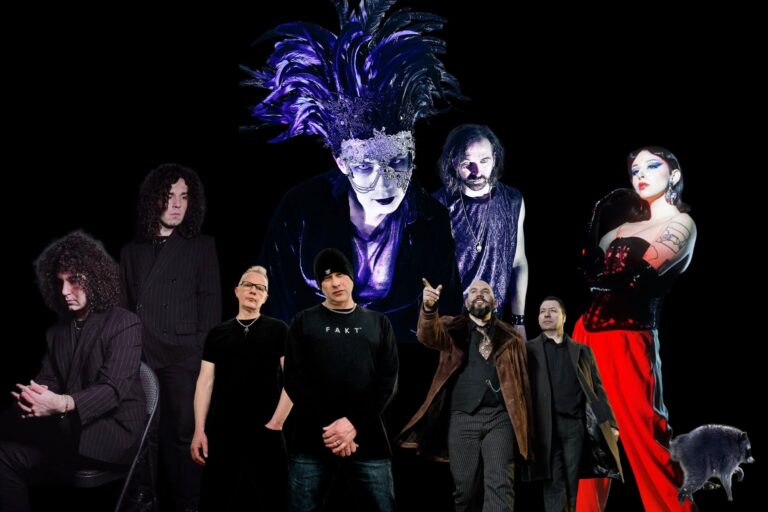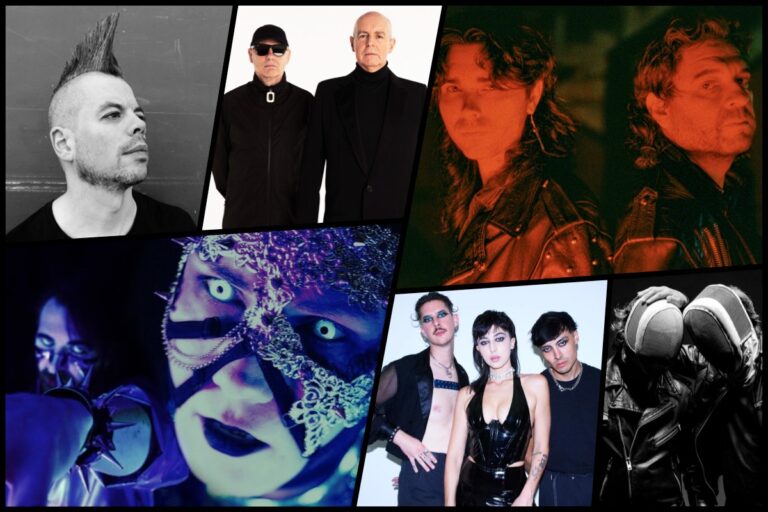
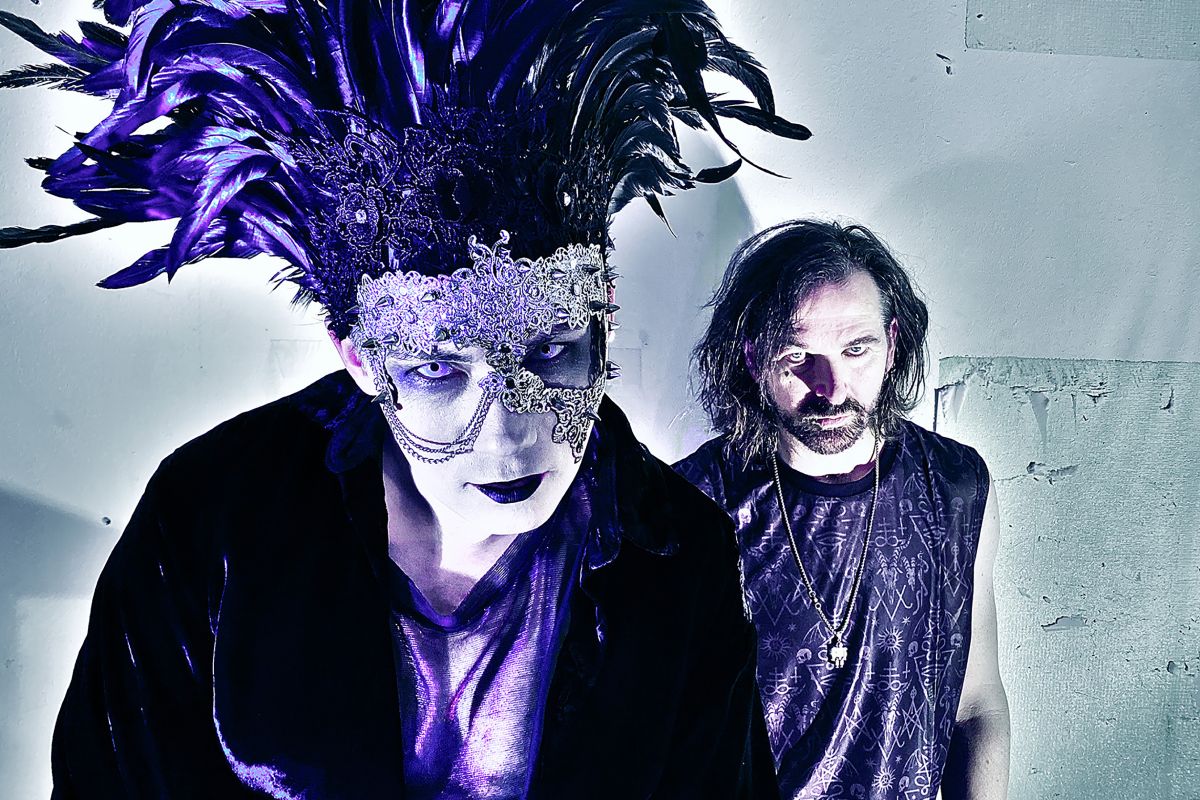
Dead Lights don’t just make electronic music. They smear it with eyeliner, sharpen its claws, and drag it onto the dancefloor. Since making their debut in 2020, the act has carved out a decadent world of glitter-trash theatrics and electro-goth sleaze.
The duo, comprised of musicians Saul and Richard, drops their third album Lash on May 15. We’ve already heard a handful of pre-release singles, including “Resonate” and “(The Edge of) Dusk,” that demonstrate depth and dimension without sacrificing Dead Lights’ pounding beats, sharp hooks, and lavish visuals.
On the eve of the album’s release, I reached out to Saul and Richard to learn more about their creative process and the beautifully warped world of Lash. Here’s what they told me.
When I first started writing about Dead Lights, I mistakenly described you as a traditional singer-producer duo (à la the Pet Shop Boys). Let’s clear things up. How does each of you contribute to the project?
Saul: Well, we’re both established writers and producers in our own right, long before we started Dead Lights. Richard is far more prolific in this aspect, but I’ve released many albums as a singer/songwriter/producer over the years. I’ve also co-produced albums for other artists, and I’ve done some remixes for the likes of Massive Ego. Long story short, I came into Dead Lights as not only a singer, but also as a writer and producer.
While it’s definitely fair to say that Richard writes more of the music and does more of the production for Dead Lights than I do, I usually contribute to almost every song in some way. Sometimes it’s just adding a couple of synths or tweaking the arrangement to flow better with my newly added vocals. Other times, I’ll write a new chorus or mid-8 section. Occasionally, I’ll write a full song and our roles will reverse, where Richard will add some synths, production and tweak the arrangement.
It’s a very fluid process, and I very much enjoy contributing to Dead Lights in more ways than just as a vocalist—not to diminish the role of a singer and lyricist—but up until starting Dead Lights I’ve always been a songwriter and producer first, then a vocalist second. I’d probably get artistically frustrated if I couldn’t contribute to Dead Lights in terms of writing some of the music! I enjoy it immensely and find a lot of satisfaction in it.
Richard: Your preconception is understandable. Most electronic duos work like that. But with Dead Lights, it is indeed a much more equal situation. As composers and producers, we have the advantage of combining our skills, which keeps the process of writing and producing fresh and exciting.
Like Saul said, I probably do the biggest part of the instrumentation, but Saul adds new sections within songs, and most of the time rearranges them to fit the lyrics. Sometimes I will send over just a basic bass line and beat, and Saul will add a lot of new parts, sometimes the instrumental version is quite arranged and needs few adjustments.
All lyrics are written by Saul, and they are a big and defining part of Dead Lights. They also often dictate the atmosphere of the song, as well as the other way around.
You started Dead Lights during the pandemic and worked remotely from different countries. Do you still collaborate that way today, or has your process evolved?
Saul: Our process has actually stayed the same! When we do find time to meet in a casual setting (by which I mean not at a show), we usually have a normal band rehearsal (as opposed to rehearsing separately, which is what we do 99% of the time), or shoot a music video, or exchange ideas relating to our music and stage show—sometimes a mix of all of those things.
I’m used to working in isolation when creating music—it’s just the way I’ve always worked, so it’s perfectly normal for me. Plus, it gives me time to mull things over for extended periods without anyone else getting bored!
I’m very particular with my input. If I’m making a chorus section, for instance, I usually end up making at least three or four different ones before I come up with something I like, the rest gets scrapped. I also spend a huge amount of time on my lyrics, although my vocal melodies tend to be very quick to get down with a guide track, so that’s something at least!
Richard: When we decided to start this band, the idea was to come together in one of our studios to finalize the demos we’d send each other via Dropbox. Like you said, the pandemic changed that plan. But we quickly discovered that working remotely works very well for us.
When we started out, we spent some time defining and aligning our ideas for what Dead Lights should be. Not only musically, but also visually. I think the reason that it worked and still works so well is because we are very much in sync about where we want to take the band and what it should communicate.
After the pandemic, we didn’t feel the need to change our M.O., because it worked so well. Like Saul, I can have a 4-bar section on loop for an hour, trying to find exactly the right groove or sound. It’s very nice when you can do that without having the feeling that other band members are losing their minds, haha. We are both obsessed with finding the exact specific sound for every instrument and the right atmosphere for each song, and this deep dive into all this works well for us in relative isolation.
I think you bring back to the dark-electro scene a sort of glamorous, grimy sleaze that was once the domain of bands like My Life With the Thrill Kill Kult, Lords of Acid, and Alien Sex Fiend. Are those fair comparisons? Who do you see as your core influences?
Saul: Speaking for myself, my main influences for Dead Lights have been artists like IAMX, Priest, The Prodigy, Gary Numan, PiG, Marilyn Manson, and The Sisters of Mercy. There are many, many others that have had a smaller influence here and there, often from a wide range of genres, but the aforementioned bands have been my core inspiration throughout the lifespan of this project.
I’m very fond of funk and hip-hop, so that has bled through into our music as well, what with those genres being heavily focussed on rhythm and groove I think you can easily hear the sleazy funk influence on many songs!
With regard to dark scene music, I honestly try to avoid listening to artists that are in the same wheelhouse as us too much, not because I don’t like that music (that would be ridiculous!), but because I worry about musical stagnation. It’s just a matter of wanting to create (and keep) our own identity, I suppose. I believe it’s very easy for bands that are part of a small scene to start influencing each other. That’s not necessarily a bad thing, but it can lead to a lot of bands eventually sounding alike. I just try to be mindful of that and look outside our scene for new inspiration whenever possible.
Richard: I’m very much into the sound of modern dark electro acts like Matteo Tura, Assalm, Mobiius, Amortal. Those are inspirational from a production point of view. With Dead Lights, we want to pull this sound into the territory of proper, old-fashioned songwriting. We just like music with verses and a catchy chorus, so it doesn’t only work on the dance floor, but there’s a depth to it composition-wise, as well as lyrically. Not that the aforementioned acts are shallow, but our universe is just different.
The bands you mentioned are indeed understandable comparisons, but they are not the kind of bands I listen to much. Core influences for me that inspire Dead Lights are too many to list! Also, I have an extremely wide musical taste and actually mostly listen to music outside of the goth/EBM/industrial realm. If I had to name one artist that never stops to inspire me it would probably be David Bowie.
There’s a strong sense of drama and flair in your visuals—the makeup, the decadence, the attitude. Are your visuals extensions of your real selves, or are they personas you step into? Where do your visual ideas come from?
Saul: Personally, I actually think it’s a mix of both. The androgyny and strangeness come naturally to me, so that is just an amplified version of the real me, but the decadence and attitude are much more of a theatrical persona. I’m a very quiet and calm person—attitude is not something you would associate with me if you knew me! I can only speculate as I’ve honestly not really thought about it before, but I’m guessing the reason I like to jump into such a persona is to express a side of myself that I keep buried, either that, or I’m indulging (or “acting out”) a personality trait I wish I had.
We take a lot of visual inspiration from people like Leigh Bowery, as well as the New York Club Kids scene’s surrealist androgyny I guess you could call it. Drag culture is hugely influential to us, not that we claim to be in that scene, we just love the outlandish creativity and decadence of it all!
It’s fair to say that we have a lot of early glam and synthpop fashion influence in what we do: David Bowie, Gary Numan, Soft Cell, Pete Burns/Dead or Alive, Visage, Japan, Roxy Music—the whole gamut really! Hell, I would even cite Kiss as a big visual influence! We obviously also have a lot of goth influence, although I wouldn’t point to a specific era or subgenre of gothic culture, we take inspiration from many different parts of it.
Richard: Looking back to when I was a kid, my first two role models were Ace Frehley from Kiss, and after that Rozz Williams from Christian Death. I think with Dead Lights I ended up as a combination of those two, haha. At least, that’s how it feels internally for me. The gothic, poetic, arty androgyny of Rozz, combined with the relativising, no-nonsense “it’s only rock ’n’ roll” attitude of Ace.
The androgyny is a clear way to express that you’re unafraid of breaking common conceptions. Not only by denouncing a gender affirmative appearance, but it also implies that it extends to the artistic output. It reflects a mindset that fits what we want to communicate with our music. I think going 100% for what you want to do and being unapologetic about it is what defines attitude. It’s what draws people in because the message is clear. And also: when it’s fake, people will know. So it definitely has to connect to your SELF. And well, it’s the only way to do anything in life, really.
Let’s talk about Lash, your third album. In the press notes, you describe it as “lesions of low art” and talk about the tension between low art and high art. What does low art mean to you, and why embrace it so fully?
Saul: “Lesions of Low Art” was actually my pitch for the album title, and it almost was, but then Richard suggested Lash, and after a bit of thought I agreed that it makes for a punchier, sleazier album title! However, we still liked “Lesions of Low Art” so much that it became the subtitle of the record, especially seeing as it’s a running theme throughout the album, so it made sense to do so.
With regard to the meaning of it, it felt to me that our music (and my personal artistic intentions/aspirations with Dead Lights) really straddle the line between high-brow and low-brow. On the surface we make trashy, in-your-face dance music, but underneath that is always a higher intent, bubbling away under the pounding beats and mammoth bass lines!
We play a lot with texture, atmosphere, concepts, non-linear song structure, and we always make concerted efforts to bring in influences from outside the sphere of the dark-dance genre we operate in. Not to mention the exorbitant amount of time I put into my lyrics! Not that we claim to make “high art” but we do try to add some depth to what we do—find a satisfying balance between heartfelt artistic expression and melting people’s faces with thunderous beats!
Richard: There’s a strange (manufactured) gap between “low art” (popular culture) and so-called “high art.” I have one foot in each, as I also exhibit audio-visual installations in galleries and compose music for many modern ballet companies and perform in posh theatres. There’s a lot of solemnity in the “high art” world, just like in the military and in the monarchy. Solemnity in the form of not being serious, it’s the performance of seriousness. But these spaces are easily disturbed, revealing their absurdity.
We embrace that same absurdity with our “low art” (being pop music), where it unapologetically takes the shape of outrageousness and extravaganza. Yet, recognizing the fact that every rebellion eventually ages into a design style, we wanted to make Lash gorgeous enough to pull you close and sharp enough to cut once you’re there, leaving “lesions of low art.” So the subtitle also refers to whip marks that signify a lasting impression.
I love “(The Edge of) Dusk” so much, but it’s more restrained, more melancholic than most Dead Lights songs. The tension sorta simmers. What drew you in that direction?
Saul: You can usually find a slower, more melancholic song on each of our releases. It’s not our bread and butter, obviously, but it’s been a part of Dead Lights since we started. There are cuts like “Witching Hour,” “Ice Queen,” “Follow Me,” and “Drown with You,” all from previous releases. “Dusk” could well be our most restrained song yet, though certainly for a single! The lyrics came from a few different places, but one of us experienced a very tragic loss only a few days before I put pen to paper, and that sense of sadness had a profound effect on what came out.
Richard: We do indeed have more softer songs, but I think this one really turned out well in terms of combining our more modern sound with accessible melodic elements. Also, the music and lyrics are in perfect harmony. We set out to create a proper synthpop song, and this is what came out. We do tend to stretch our sound into other subgenres without losing our identity. We wouldn’t want to become too predictable!
You’ve written a song inspired by Poe, you mention Picasso when talking about Lash. Those feel like apt references for Dead Lights. Who are some surprising artists or authors that have shaped your identities?
Saul: There’s an ongoing dystopian theme that underlines a lot of what we do, both in sound and lyrical content. Sometimes it’s more sci-fi in nature, other times it’s more grounded in the current dystopian world we find ourselves in! Writers such as Arthur C. Clarke, Aldous Huxley, George Orwell, and Alan Moore have had a clear impact.
I watch quite a lot of films, so many of the dystopian and cyberpunk classics form a large part of our DNA. Blade Runner aside, there are far too many individual films to list, but the work of Stanley Kubrick, Alex Garland, David Lynch, David Cronenberg, and Paul Verhoeven are all of note. Verhoeven in particular has always resonated with me—as well as often feeling wonderfully “trashy,” his sardonic and satirical approach simply oozes out of much of what I write!
Surrealist and abstract art is something I also have a deep fondness for, the distortion of convention and viewing reality through a warped lens is something I aspire to do with everything I create. Dali and Bacon would be prime examples.
Leonard Cohen and Andrew Eldritch deserve a mention as my biggest lyrical influences, anyone familiar with their work can probably hear their influence in many songs. Those are artists who have left an imprint upon my work with Dead Lights. There are so many others who have influenced me as an artist and person in general, but I think my answer is already long and rambling enough without needing to dive deeper into more of the weird stuff I like.
Richard: I love surrealism and especially Dadaism. Max Ernst might be my favorite artist from both genres. His collage novels are very inspiring.
I went to art college myself and also create audio-visual (light & sound) art installations. In that field, artists like Olafur Eliasson and James Turrell are amazing. I could go on for an hour about inspiring and wonderful artists. There are so many fantastic new artists, in every discipline. It’s a great time to be alive!